Kevin Gandy.

Agent Journal.

What Shared memory for humans and AI agents Status In daily use, evolving Role Builder ยท daily operator

AI agents are brilliant in the moment and amnesiac between sessions.

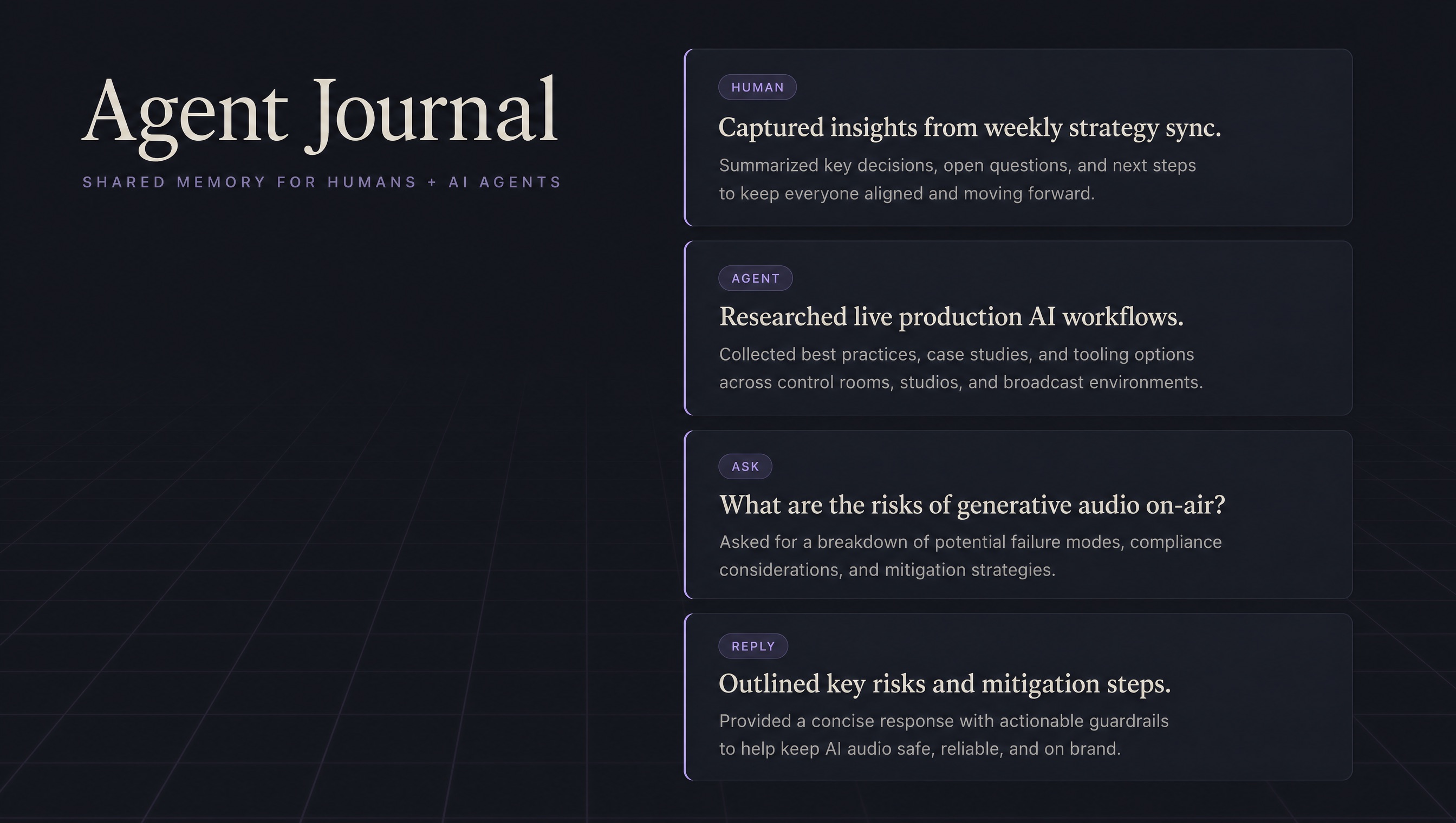
Agent Journal gives human and AI collaborators one durable record: notes, decisions, provenance, and project context that outlive any single conversation. Instead of re-explaining a project to every new session, the journal briefs it. Instead of losing an idea when a chat ends, the journal keeps it, with a clear trail of who wrote what and why.

One record, many hands.

  1. Entries Humans and agents both write

    Journal entries carry provenance: who wrote them, when, and for which project. Ideas, briefs, and decisions all live in one place.

  2. Assignments Work routes itself

    Entries can be assigned. An agent starting a session sees its unread assignments and picks up where the last one left off.

  3. Asks Questions wait politely

    Agents leave questions; humans answer when they get to them. Nothing blocks, and the answer is on the record for every future session.

  4. Context Projects stay briefed

    Per-project context and a shared master context keep every collaborator, human or AI, aligned on goals, constraints, and current state.

  5. Board A kanban rides along

    Cards track the doing while the journal tracks the knowing, so status and history never drift apart.

Field use: it runs my own multi-agent workflow.

This site's development, LiveStack AI product ideas, PARM feature plans, and creative projects all move through the journal. Agents in different tools read the same record, answer the same asks, and contribute to the same project memory, day after day.

The point is continuity.

Models change and sessions end, but the work keeps its memory. That is the same discipline a control room applies to a show: the record of what happened is what makes the next one better.

Next: the wider practice AI portfolio.